×

Spring in the bush is not always very obvious.  It’s rather more subtle.  Every once in a while there is a hint of a floral fragrance in the air.  And every once in a while as one wanders through the still brown trees and bushes, who are desperately waiting for those first proper rains, there is a hint of more demure floral activity dotted amongst these trees and bushes.

And this demure floral activity is beautiful.  Beautiful in a subtle way, beautiful in that you need to pull in close to really look at the blossoms to appreciate their beauty.

The Climbing Bushwillow (Combretum mossambicense) is one of the first to send forth its blossoms.  

Seen from a distance, the flowers look like little white balls dotted around on the stems.  But seen up close and personal, the flowers are really pretty.  Each clump of flowers contain both male and female reproductive parts within the same flower.  You can see the anthers are the pretty orange-coloured dainty looking tall parts at the top of the filament, surrounded by the smaller petals which are a beautiful salmony orange colour.  Really beautiful with the sunlight shining through them. 

Moving to the bush was so exciting and the best thing which has ever happened, in fact, so much so that we have spent the first few years being absolutely amazed by just everything – in a larger picture type of way.   And while we had certainly noticed certain things, like the flowers from the male marula tree, we hadn’t really noticed them, in the sense of actually placing them where they originate from.   

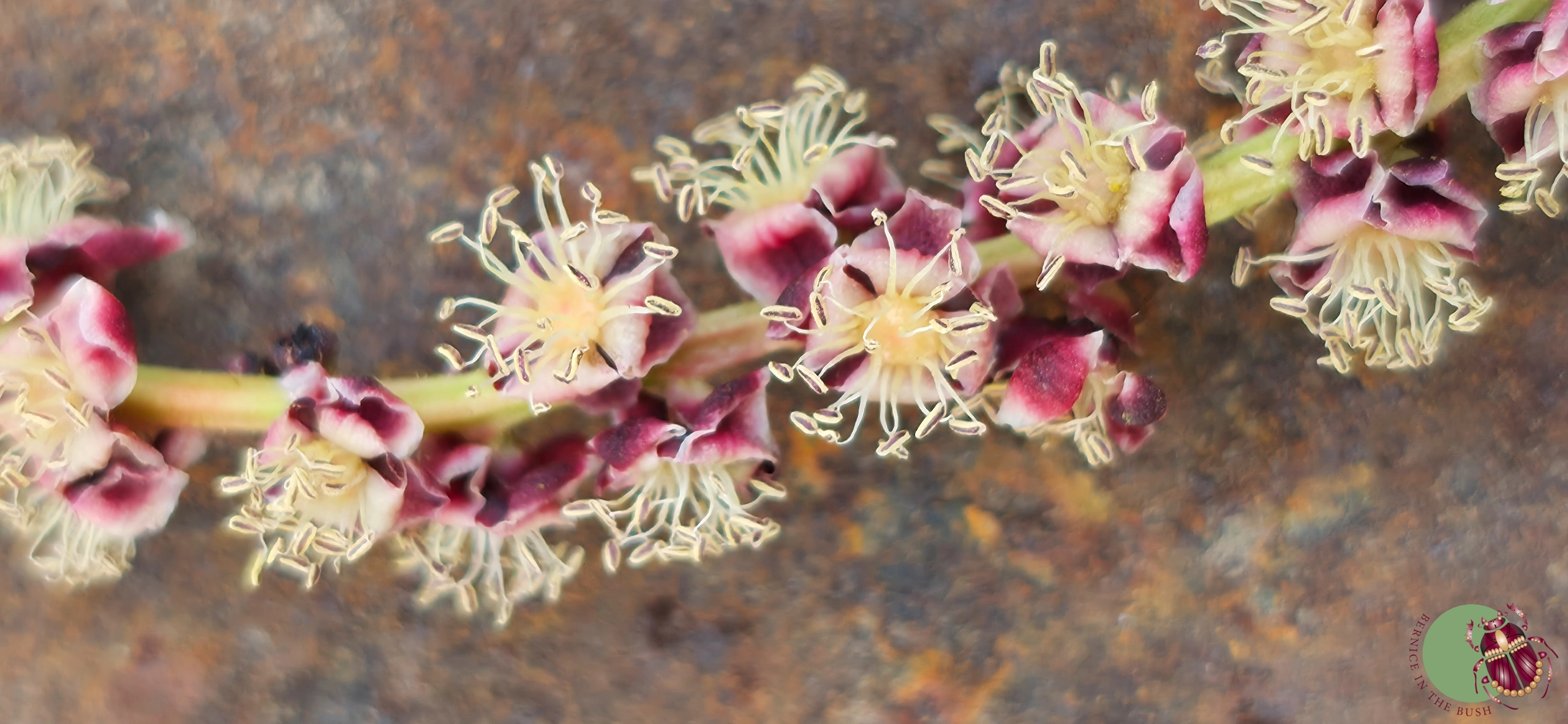
This season, we have actually noted properly the marula flowers.  And again, we are mind-blown by their intricate beauty.  Particularly as the long,  rather delicate flower stalk with it’s incredible pink flowers, turns out to actually be the male marula flower!

Marula trees (Sclerocarya birrea) are what is known as dioecious, meaning they have both male and female trees – the male tree producing one type of flower and the female a different type.

Male marula flowers

The female flowers are slightly less showy, but also really pretty.

Luckily we have both male and female trees, so we can always look forward to the marulas in marula season.

Female marula flowers

On one of our daily walks out and about with the dogs, where we enjoyed the fact that the C. mossambicense was blossoming, we noticed that the Star Chestnut (Sterculia rogersii) had also sprung into bloom.  The Star chestnut I have to say is one of my favourites.  Everything about this tree is awesome, and included in this are the flowers which really are super pretty.

Honestly, if you had to mix these 2 colours to make something one would wear, for example, it would just be garish, but put the colours together in a blossom, and you have incredible beauty.

While I was busy admiring the flowers and focusing on taking pictures, I noticed a rather large ant who was also interested in the same flower.  At first quick glance I thought the ant had yellow markings and of course I got all excited about this, and then I realised the ant was actually covered in the pollen from the flowers. 

I could not find any literature that states that ants are a key pollinator for the star chestnut, and I’m also not 100% sure which ant this is – there are over 70 genera of ants in southern Africa.  I would assume however, given that the ant was covered in pollen, that somewhere along the line, this does aid in pollination.  For myself, I found the black ant, covered in yellow and running around in the yellow and pink flowers, absolutely fascinating and rather prepossessing.

The Dwarf Bush-Cherry (Maerua parvifolia) is another early spring bloomer, which pops out at you while wandering through the bush.  As you can see it’s very green among the brown bushveld background.  The creamy-yellow flowers also have these long tendrils (the filaments) which look like they’re waving around, hoping to grab your attention, which of course, they very successfully do.

In this picture you can see 3 flowers, each in a different stage of being “open”. 

Just so delicate and dainty.

The “main” road leading to and from wherever we need to travel, is a gravel road, which means  you cannot really speed too fast along there, and this gives one the opportunity to notice various things while driving along, and what I have been noticing, is the wild cotton (Gossypium herbaceum).  This always reminds me of my mom, who had a special piece of wild cotton she kept in a pretty box, although I never did find out the story behind it.   The plant is very pretty with its drops of fluffy cotton bursting from their pods.

And moving on from cotton to velvet, the Velvet Corkwood (Commiphora mollis) is also in bloom.  However these blooms you have to really get up close and personal to see.  You honestly could quite easily miss them if you weren’t looking closely.  The flowers are very tiny, and the breeze, along with the miggies which all of sudden decided I was their best friend, made taking photo’s of them rather challenging.  But worth the attempt, nonetheless.

So, as you can see, spring in the bush is not about being showy and glamourous, but rather about attracting the eye of those who are able to see the beautiful by looking closer and deeper, and appreciating that beauty does not have to shout to be noticed. 

Author

berniceinthebush@gmail.com

Related posts

Along the way

A colleague/friend kept finding spiders to show me every time we were in the bush together.  Now anyone who knows me, knows...

Read out all

Aloe Aloe

Winter time is aloe time and aloes are absolutely one of my favourite plants.  I’ve always loved them, and since we’ve moved...

Read out all

Of a day

Our camera trap stays up for a week at a time wherever we decide to place it.  We have had it opposite...

Read out all

Down by the River

In the winter months, when the rains don’t fall, we are very lucky to be able to head down to the great...

Read out all

SGOTY

SGOTY Every year there is a competition held which ultimately celebrates a number of guides nominated to participate in the Safari Guide...

Read out all

It started with a Giraffe

It started with a giraffe We were awoken this morning with a “view from our window” of a browsing giraffe, and then...

Read out all