Aloe Aloe
Winter time is aloe time and aloes are absolutely one of my favourite plants. I’ve always loved them, and since we’ve moved to the lowveld, they’re even more special as they brings some much needed colour into ones life while everything else around you is winter bushveld brown.
Aloes are clearly not favoured only by me. A wide variety of birds love them, as do a large number of insects, and of course, we all love the aloes for different reasons! Aloes must be a very tasty and nutrional food source for both birds and insects, during the winter months, when not much else is available. I’m sure the nectar is particularly delicious.
This is not a one-way relationship. And while the aloes provide nourishment to the various birds, the birds give back by providing a pollination service. The pollen sticks to their beaks and feathers on their heads, and then gets transported to the next set of flowers, where it then does what it has to do – pollinate.
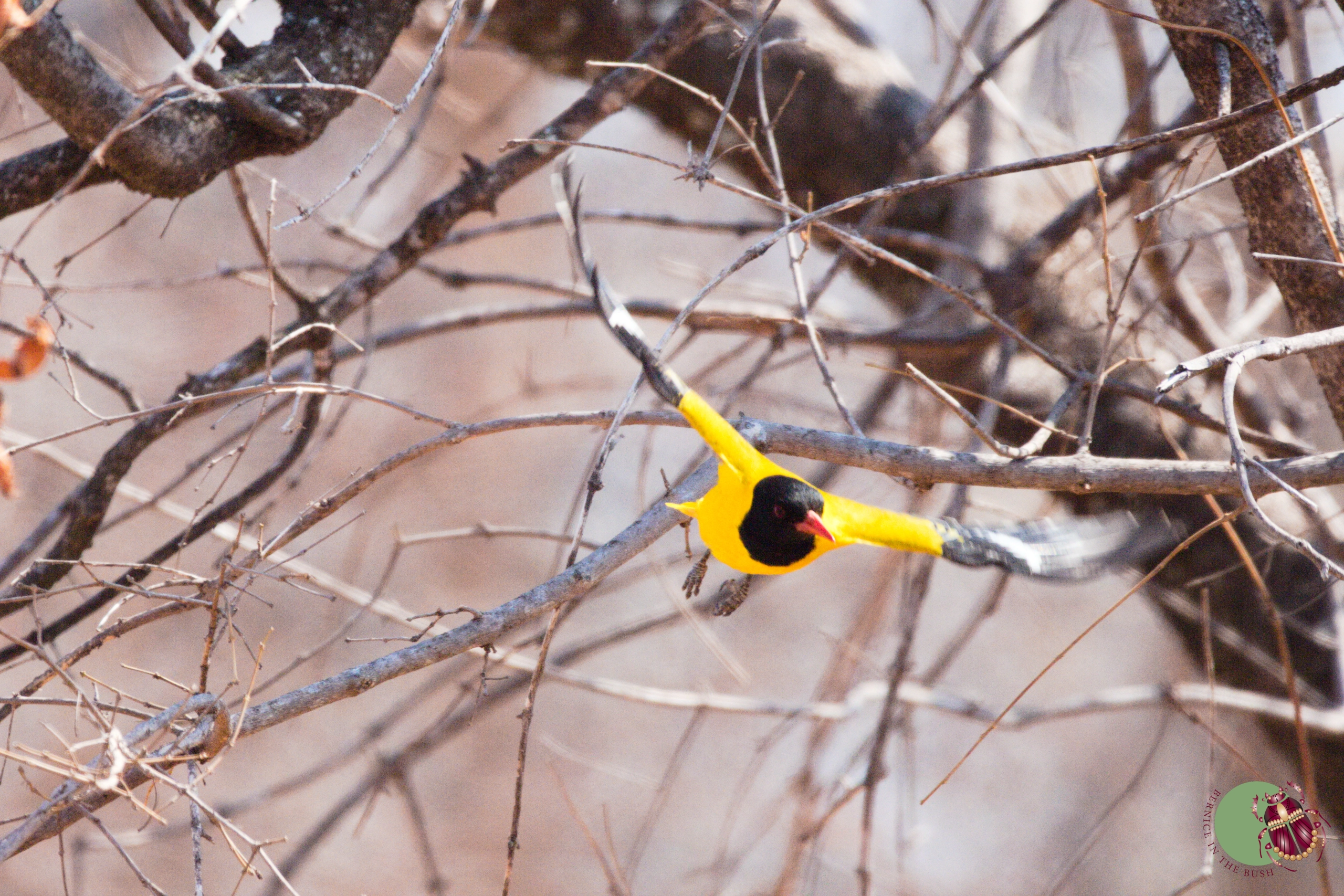
The predominant aloe species in our garden is Aloe marlothii. When I photographed this Black-headed Oriole, it was very clear that he had been enjoying the feasts of the aloe, with the pollen stuck to his face feathers, the orange of the pollen complementing him perfectly. Such beautiful birds. They become very vocal when the aloes are in bloom, calling constantly. Someone once told me that the oriole is an all-rounder for beauty – beautiful looks, call, nest and eggs.
Another very common visitor, also extremely vocal, is the Grey Go-away Bird. Although I do love them because they have a lot of character, I always think of them as skelms (there isn’t really a proper English word for this, it’s almost like a rascal, but with a bit more force than just a rascal). And one can almost see this by the way they gobble up the flowers as if they were going to be stolen from right under their beaks. You can just see that naughty, almost defiant glint in the eye …
While focusing on the aloes and trying to get some good shots of the starlings, I heard a very distinctive call. The Grey-headed Bush Shrike. In Afrikaans – spookvoel, which translated means ghost bird. This is not because it looks like a ghost, but because it has a very distinctive call. Its call is one very long, almost haunting note. It is one of my favourite calls, as it’s one of the birds which – before moving to the bush – when I heard it, I’d know I was “in the bush”. They are also rather elusive and don’t always perch themselves in full view. However, this day I was in luck, because there it was, displaying it’s beauty, in full view.
In the meantime, the Cape Starlings were displaying their glorious blues to their full extent in the sunlight. With their golden eyes a close match to the colour of the aloes, and where their feathers overlap, depending on the light and angle, it looks like beautiful dot art decorating their wings, one cannot help but take stock of how each bird is so different to another, yet each one is so special.
It seems like the visits to the aloe restaurant are mostly taken in turns, although every now and again, you do see 2 different species on one plant.
Aren’t these birds magnificent? The contrasting black and yellow of the oriole and the contrasting “black” and red of the Scarlet-Chested Sunbird, along with the yellow of the aloe, really do brighten up the stark winter surrounds.
The Scarlet-Chested Sunbirds are the most common sunbirds in our garden. I know I keep saying all the birds with their colours are incredible, because they all are! And I’m going to say it again. I never tire of looking at these sunbirds. Their iridescence changes all the time, so they never look the same. They can appear pitch black and red, and less than a second later, they have this glorious turquoise where the black was. Such deep rich colours, they are truly splendid.
Of course, sun-birds are true to the fact that the male is much prettier than the female. This is very obvious in nearly all the sunbirds, where the female is rather drab compared to her male counterpart, although she remains pretty in her own right.
The White-bellied Sunbird is no different and is our other commonly occurring sunbird. You can definitely see here the difference between the male and female. And again, so different to the Scarlet-chested Sunbird, but again, you just cannot get enough of looking at those incredible colours as he moves around from flower to flower. Even his tail feathers radiate the turquoise and greens, not to mention his beautiful chest with the band of purple.
A less frequently seen (by me) sunbird, the Marico Sunbird, also pops past at times for a quick aloe snack. The male Marico sunbird has a magnificent purple band across the chest which caught in the right light, and sandwiched between the green and red, truly is breathtaking.
Not all the visitors to the aloes have such flashy and dashing colours. The Dark-Capped Bulbul, also a more regular visitor, has more somber colouration, with a splash of yellow under his tail.
Very exciting for me, as I’d never come across these before, another visitor to our aloes, allowed me to add a new species to my birdlist. The Common Scimitarbill. In my mind I’d been seeing a Green Wood-Hoopoe, but I knew something just wasn’t right with this. The bill is obviously a different colour, and shape, but I wasn’t sure if this was a juvenile, or …? Imagine my excitement when I discovered that actually, this was a new bird for me.
The iridescent colouration of the Scimitarbill is not the same as the sunbirds. He has every right to proudly display his royal blues and purples adorned with his white tail markings to provide the final touch.
The aloes have now finished blooming and the birds have started with nest building. I will keep you posted!
Author
berniceinthebush@gmail.com
Related posts
Along the way
A colleague/friend kept finding spiders to show me every time we were in the bush together. Now anyone who knows me, knows...
Read out all
Subtle Spring
Spring in the bush is not always very obvious. It’s rather more subtle. Every once in a while there is a hint...
Read out all
Of a day
Our camera trap stays up for a week at a time wherever we decide to place it. We have had it opposite...
Read out all
Down by the River
In the winter months, when the rains don’t fall, we are very lucky to be able to head down to the great...
Read out all
SGOTY
SGOTY Every year there is a competition held which ultimately celebrates a number of guides nominated to participate in the Safari Guide...
Read out all
It started with a Giraffe
It started with a giraffe We were awoken this morning with a “view from our window” of a browsing giraffe, and then...
Read out all