×

I know it’s been a while since I posted but I did want to continue on from my previous post, as there were so many wonderful insects we saw, it would be a shame not to share them, even though it’s a bit long after the time.

There were so many there was just no way they were all going to fit into my previous post about my wonderful few days away in the bush, looking at and photographing any insect willing to be looked at and photographed.

Besides all the bugs (as in true bugs – hemiptera) which we saw (Many Insects make me Happy Part 1) we saw many many other wonderful and exciting little creatures and things of beauty.

So spiders are not insects, but we did come across a large variety of different spiders, some hidden in specially folded leaves, others under bark, others on flowers, some very well disguised in the grasses.  They are such amazing creatures, but sadly they are rather misunderstood  and a lot of people are scared of them.   However, once you actually start to really look at them, you start to see their intricate beauty.   We do not have many venomous spiders in Southern Africa, with 5 species being recognised as medically significant, which means that if you do get bitten by one of these spiders, it is suggested that a doctors visit might be on the cards.  South Africa has over 2,200 species of spiders (approximately), so you can see the medically significant number is very minimal. 

Garden Orb (Argiope)
Banded-legged Golden Orb (Trichonephila)

Orb web spiders are these absolutely amazing spiders, and I do admit they could be perceived as being rather scary, based on size.  The spider can be quite large, and the web can also be rather large.  The webs are built quite high up, strung between trees.  The golden orbs produce a web which is beautifully golden in colour.  The webs of these spiders can be incredibly strong and are very easy to walk into if you’re concentrating on where to put your feet rather than paying attention to what’s directly in front of you. 

Just remember though, that 9 times out of 10, if you do walk into the webs, the spider will not land on you.  It very cleverly either runs very fast on one of the broken strands to safety or bungy’s to the safety of a branch.  

I remember the first time I ever encountered one of these spiders, was when I was visiting my cousin on the farm.  We were heading off to a sundowner spot and us younger ones were standing in the back of the bakkie.   All of a sudden my cousin yelled “duck” and pulled me down (quite “violently”).  When I looked back the web was glowing golden and stretched all the way across the road, with the spider smack bang in the middle of it.  If I hadn’t ducked, my face would have planted right in the middle of her.

Both spiders in the pictures above are female, as the males are very much smaller, and more drab.  You can see both of these spiders have enjoyed a delicious breakfast, so the males are safe for now … 

In the picture below, you can see just how small the male is compared to the female and this particular male is cashing in on his luck while the female is involved in her meal.

There was an abundance of grasshoppers of all different shapes, sizes, types and colours to be found.  Before moving to the lowveld, I had no idea that such a variety of grasshopper species existed.  They are amazingly crafted little works of engineering.  

We were lucky to see a grasshopper ecdysing.  This means it was leaving its old skin behind, and emerging as a bigger grasshopper in its new skin.  The whole process involves a lot of wriggling and squeezing, as you can well imagine.  The newly emerged little hopper is then extremely vulnerable for a while, until everything hardens, fills out and basically falls into its new place.

Waiting for everything to harden so that he can move on
Look at the eyes
grasshopperbladder
Just look at the beauty in this bladder grasshopper. The incredible details. It's just amazing.

Bee Flies are really hard to photograph, as they never stay still.  A bit like most butterflies!  Because it was a bit overcast, they seemed to be a bit less “buzzy” and I managed to photograph two different species.

Bee flies are not bees at all, they are flies.  But they are super cute and furry, and are important pollinators.  What I did find out however, is that even though they’re cute and fluffy, their larvae are parasitic and feed off or consume the host species’ offspring. 

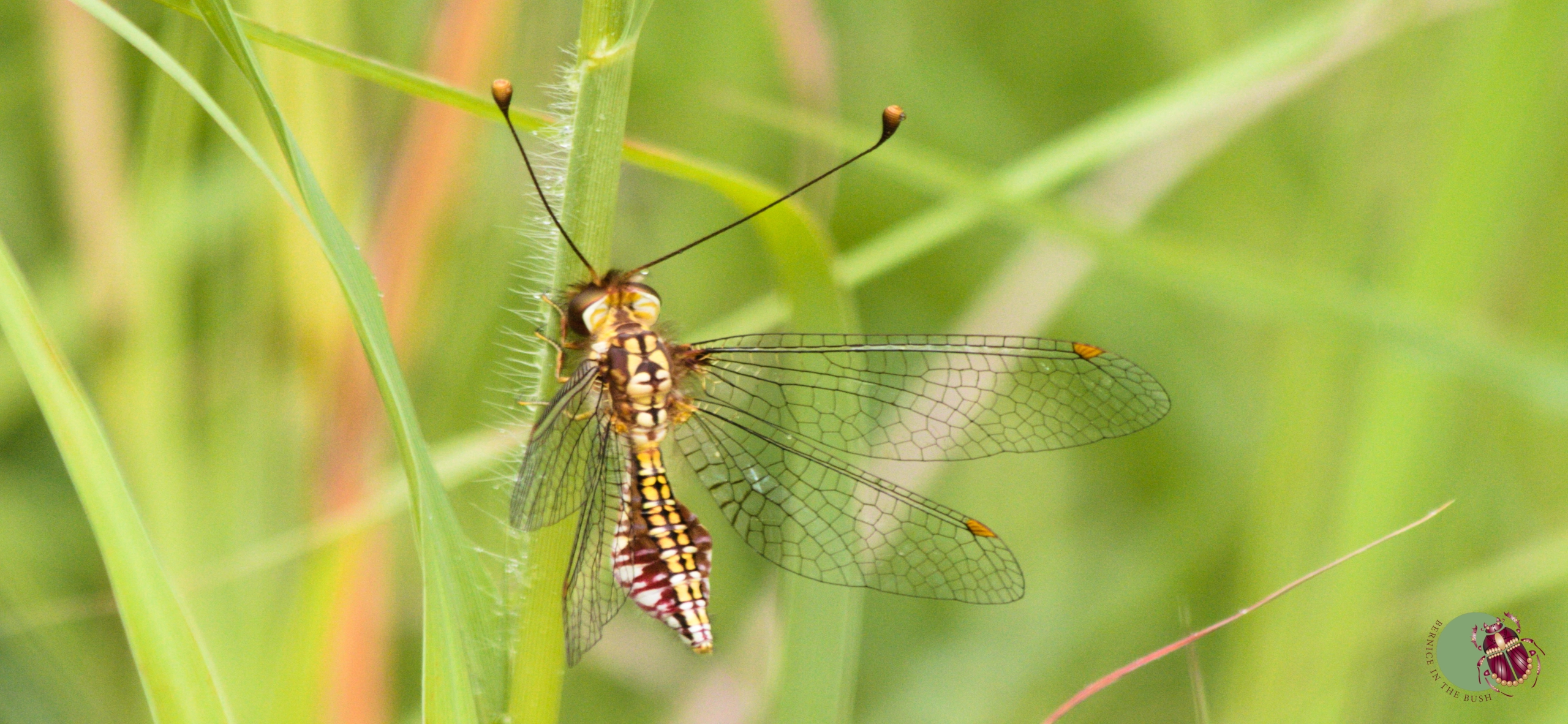
Something very exciting and brand new for me, was the discovery of an owl fly.  We actually saw two different species, which was super cool (from 0 to 2!) and both were so very different, but my pictures of the other one unfortunately were all blurry.  That one was black and really beautiful as well.

There is going to be a part 3 to this theme…

There are still so many exciting insects which we saw and I need to share with you, but if I carry on here, it will just be too long. 

See you for part 3.

Author

berniceinthebush@gmail.com

Related posts

Many Insects make me Happy

Many Insects make me Happy …/1 In that mixed period of time where one is still basking in the effects of a...

Read out all

Reflective Eyes

I went outside quite late one evening because I heard a noise, so I thought I’d venture out to see what I...

Read out all

Along the way

A colleague/friend kept finding spiders to show me every time we were in the bush together.  Now anyone who knows me, knows...

Read out all

Subtle Spring

Spring in the bush is not always very obvious.  It’s rather more subtle.  Every once in a while there is a hint...

Read out all

Aloe Aloe

Winter time is aloe time and aloes are absolutely one of my favourite plants.  I’ve always loved them, and since we’ve moved...

Read out all

Of a day

Our camera trap stays up for a week at a time wherever we decide to place it.  We have had it opposite...

Read out all